

Government Revives Cold War-Era "War Book" Ahead Of Largest Home Defence Exercise In Decades
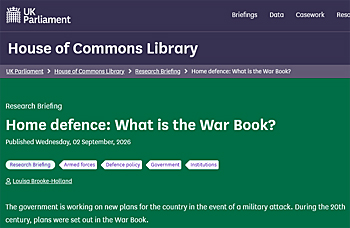
The UK government is updating its War Book, the classified blueprint for moving the country from peace to war, and will test it in a major home defence exercise in 2027.
In a written statement to Parliament on 14 July 2026, part of the annual statement on national resilience, ministers said they had accelerated home defence planning, including updating the War Book. The government said the work would be tested in 2027 in what it described as the largest UK home defence exercise in several decades.
The statement was made by Darren Jones, who said the plans would be rigorously tested so the country is ready should the worst ever happen. The exercise has been reported under the name Albiston Shadow, though reports vary on whether it is an "operation" or an "exercise". It is expected to involve cabinet ministers, military personnel and hundreds of public sector officials wargaming the response to a sudden, coordinated hybrid attack.
 What must keep running
At the heart of any such plan is the government's list of critical national infrastructure (CNI). The government defines national infrastructure as the facilities, systems, sites, information, people, networks and processes a country needs to function and that daily life depends on. It groups these into 13 sectors: chemicals, civil nuclear, communications, defence, emergency services, energy, finance, food, government, health, space, transport and water.
Not everything in those sectors counts as critical. The official CNI definition covers only those elements whose loss or compromise could have a significant impact on national security, national defence, or the functioning of the state. Only a fraction of assets in each sector carry the designation, and the list of those assets is not published. Several sectors also have sub-sectors. Emergency services, for example, split into police, ambulance, fire services and the Coast Guard.
| Sector | Examples of what it covers |
|---|---|
| Chemicals | Industrial chemical production and storage, including supplies used in water treatment |
| Civil nuclear | Power stations, fuel handling and waste storage |
| Communications | Broadband and mobile networks, broadcasting, postal services |
| Defence | Military bases, equipment and the supply chain behind them |
| Emergency services | Police, ambulance, fire services and Coast Guard |
| Energy | Electricity generation and the grid, gas and oil supply |
| Finance | Banking, payment systems and markets |
| Food | Production, processing, distribution and retail |
| Government | Central and devolved government, key sites and systems |
| Health | Hospitals, health service IT and medicine supply |
| Space | Satellites and ground stations, including positioning and timing services |
| Transport | Aviation, rail, ports and roads |
| Water | Drinking water supply and sewage treatment |
Responsibility is shared. Each sector has a lead government department responsible for making sure protective security is in place for its critical assets. The National Protective Security Authority (NPSA), part of MI5, advises on physical and personnel security. The National Cyber Security Centre (NCSC) covers protection from cyber attack.
The sectors also depend on one another, so a failure in one can cascade into others. Reports on the exercise describe scenarios involving cyberattacks, extreme weather and infrastructure failures that could wipe out electricity, water, phone signal and food supply chains.
What the War Book is
The War Book is the cross-government plan for a transition to war. Fewer than 100 copies were held across government in 1964, and by 1966 it had 16 chapters covering military, civil, economic and diplomatic matters. It was shelved in the years after the Cold War ended. It was last comprehensively updated in 2004, and military chiefs acknowledged earlier this year that the UK had no comprehensive national war plan. Earlier versions covered military operations, civil defence, communications, food distribution, transport and the continued functioning of government. The revised version is expected to bring military and civilian authorities into closer coordination in a crisis.
Spending and public advice
The July statement said defence spending would reach almost £80 billion a year by 2029. It also announced a national resilience public-awareness campaign for later in 2026. The household advice on keeping food, water and other supplies will cover extreme weather, flooding and other emergencies as well as war.
The government has not said an attack is imminent. One explainer noted that no minister, military chief or intelligence agency has claimed Russia is planning an autumn attack, and that the War Book asks nothing new of households.
Source: Prepared Britain / UKSN / NPSA / Red Hat / Wikipedia / IBTimes